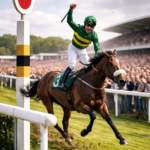
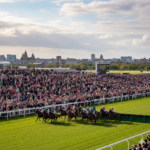
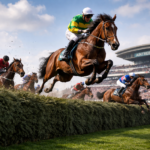
The Grand National course is a triangular, left-handed circuit of roughly 2 miles and 2 furlongs. To win the “big one,” horses must complete two laps—covering 4 miles and 514 yards—and navigate 30 legendary obstacles.
The Explicit Challenge: Why Aintree is Different
What makes Aintree the “Ultimate Test”? It isn’t just the distance; it’s a combination of three unique factors:
- The Spruce Construction: Unlike standard “park” fences made of birch, Aintree’s fences are topped with dense green spruce from the Lake District. They look solid and imposing, requiring a horse to jump with absolute precision rather than “brushing” through the top.
- The Terrain: While the track is flat, the “drops” on the landing side of several fences catch horses off guard. The ground on the far side is often lower than the takeoff side, forcing the horse to extend its legs further than expected.
- The Run-In: After the final fence, there is a 494-yard run-in to the finish line. This is the longest in the UK. Many horses have mastered the jumps only to “blow up” (run out of energy) in the final 100 yards.
The Big Obstacles: Where Legends are Made (and Hopes are Dashed)
1. Becher’s Brook (Fences 6 & 22)
Named after Captain Martin Becher, who took refuge in the brook after falling in 1839, this is the most famous fence in racing.
- The Challenge: It’s not just the 4ft 10in height; it’s the steep drop on the landing side. The landing is significantly lower than the takeoff, which can cause a horse to “peck” or stumble if they don’t get their landing gear down in time.
2. The Canal Turn (Fences 8 & 24)
- The Challenge: Immediately upon landing, horses must execute a sharp 90-degree left-hand turn. If a jockey doesn’t angle the horse correctly over the jump, they risk running wide or being carried out by loose horses. It requires extreme agility and a “handy” horse that listens to its rider.
3. The Chair (Fence 15)
Jumped only once, this is the tallest fence on the course at 5ft 2in.
- The Challenge: It is preceded by a 6ft wide open ditch on the takeoff side. Paradoxically, the landing side is raised—the opposite of Becher’s. It’s a massive physical leap that requires pure power.
4. Foinavon (Fences 7 & 23)
One of the smallest fences, but it carries a heavy history. In 1967, a massive pile-up occurred here. A 100/1 outsider named Foinavon was so far behind the chaos that he was able to navigate a gap and go on to win. It serves as a reminder: at Aintree, you must always expect the unexpected.
Horses That Conquered the Course
Some horses just “take” to Aintree. They find a rhythm in the spruce that they don’t find elsewhere.
- Red Rum: The undisputed King of Aintree. “Rummy” won the National three times (1973, 1974, 1977) and finished second twice. His ability to skip over the fences with “cat-like” agility remains the gold standard.
- Tiger Roll: In the modern era, Tiger Roll became a household name by winning back-to-back Nationals (2018, 2019). Despite being a relatively small horse, his jumping was “foot-perfect,” proving that technique often beats raw size at Aintree.
- Manifesto: A name for the real history buffs. Between 1895 and 1904, he ran in the Grand National eight times, winning twice and placing in the top four on five other occasions.
Final Thoughts
Aintree is a place of magic and heartbreak. Whether you are a seasoned punter or a once-a-year fan, understanding the “why” behind the challenge makes the spectacle even more incredible. It’s a race where a horse’s relationship with the jockey and their respect for the timber is the difference between immortality and an early exit.